I’ve spent a big part of my life sitting at a piano in audition rooms. Fifteen-plus years as a Broadway musician, more audition sessions than I could count, and, since 2018, every single SaveMyAudition class. From the piano bench you get a pretty clear view of how actors end up in the room, who decides what happens once they’re there, and where classes fit into the whole picture.
So let’s talk about it, because I think understanding how this works makes you a smarter, calmer, and more confident auditioner.
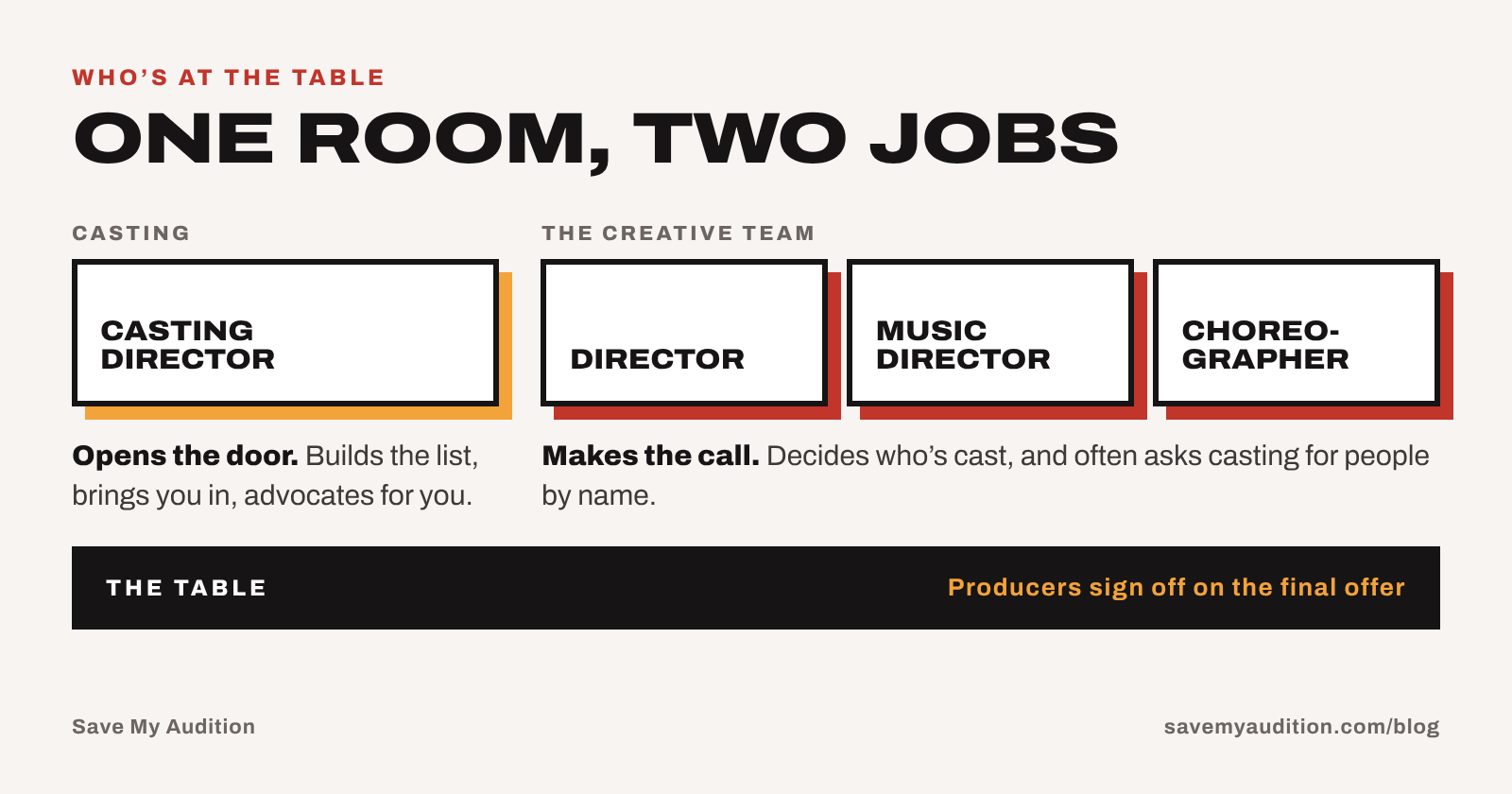
Casting directors get you into the room
A casting director’s job is to find people. When a show needs a leading lady, a character tenor, or a swing who can cover five tracks, casting builds the list. They pull from agent submissions, open calls, actors they’ve seen in shows, actors they’ve brought in before, and actors they simply remember.
Then they advocate. They bring those people in, prep the creative team, and sometimes champion someone who’s exactly right but not the obvious choice.
That’s an enormous job, and at its heart it’s a door-opening job. Casting directors are the reason you’re standing in that room.
Casting director Jason Thinger put it beautifully in one of our classes: casting directors are your advocates. Their work succeeds when you’re great. Nobody behind that table is hoping you’ll fail.
Directors and music directors do the hiring
Once you’re in the room, the decision belongs to the creative team: the director, the music director, the choreographer, and ultimately the producers. They’re the ones casting the show.
They’re also very often the ones going back to casting and saying, “Bring me that person.” A director remembers an actor from a reading. A music director remembers a voice from a workshop. That request carries a lot of weight, and it’s one of the most common ways a name ends up on a list.
Ben Cohn, the music director of Wicked, shared a great detail about this with one of our classes. When you see “REQ” next to a name on an audition list, it means someone on the creative team requested that person. A request can put you on the list. It doesn’t get you the job. That still comes down to the work you do in the room.
When it’s time to decide, casting director Kevin Metzger-Timson describes it as a puzzle. Casting can propose a range of people and even push the team to think bigger, but the director ultimately decides how the whole company fits together: who pairs well, who covers what, how the voices and dancers balance out. That’s why a “no” so often has nothing to do with the quality of your work.
Our teacher roster includes directors and music directors alongside casting directors because each one looks at your work through a different lens. A casting director, a director, and a music director will each notice something different, and you grow from hearing all three.
What a class actually is
A SaveMyAudition class is three hours in a midtown studio with a working industry professional, ten actors max, and me at the piano. You bring two contrasting pieces. You perform, you get adjustments, you try it again.
Those three hours are for working. You take a note, adjust, try something new, and find out what you’re capable of. Along the way, you get to know someone who loves this work as much as you do, and they get to know you as an artist.
Merri Sugarman calls class a confidential laboratory: a protected room to ask the questions you really want answered and try the things you’d never risk in an audition. She’s also careful never to coach anyone for an audition for her own show, because she wants every room to stay fair. Rachel Hoffman says it even more simply: class is where failure belongs. Miss in class, learn something, and walk into your next audition ready.
And you get better. Hearing how a director like Hannah Ryan, Keith Andrews, or Danny Goldstein thinks about a moment, or how a music director like Julie McBride hears a phrase, changes the way you prepare for every audition after that.
The beginning of a relationship
The best way I can describe a class is this: it’s the first chapter of a professional relationship. Relationships take time, and they’re built on more than one meeting.
That means a class is its own thing: a place to learn, to grow, and to connect with people who share your love of this work. A class isn’t a way to get a job, and it was never meant to be. What it offers is a real connection, and that’s something only time and your own work can build on.
The long game is real
I’ve been lucky to watch so many SaveMyAudition students grow over the years. Many of them have gone on to be called in for, and to book, national tours and Broadway shows through their own talent, training, and persistence.
I also regularly get texts from casting directors and music directors that go something like, “Who was that actor in your class a while back? I can’t remember the name, but I want to see them for something.” They remember the work. They remember how that person showed up in the room. And when the right project comes along, they go looking.
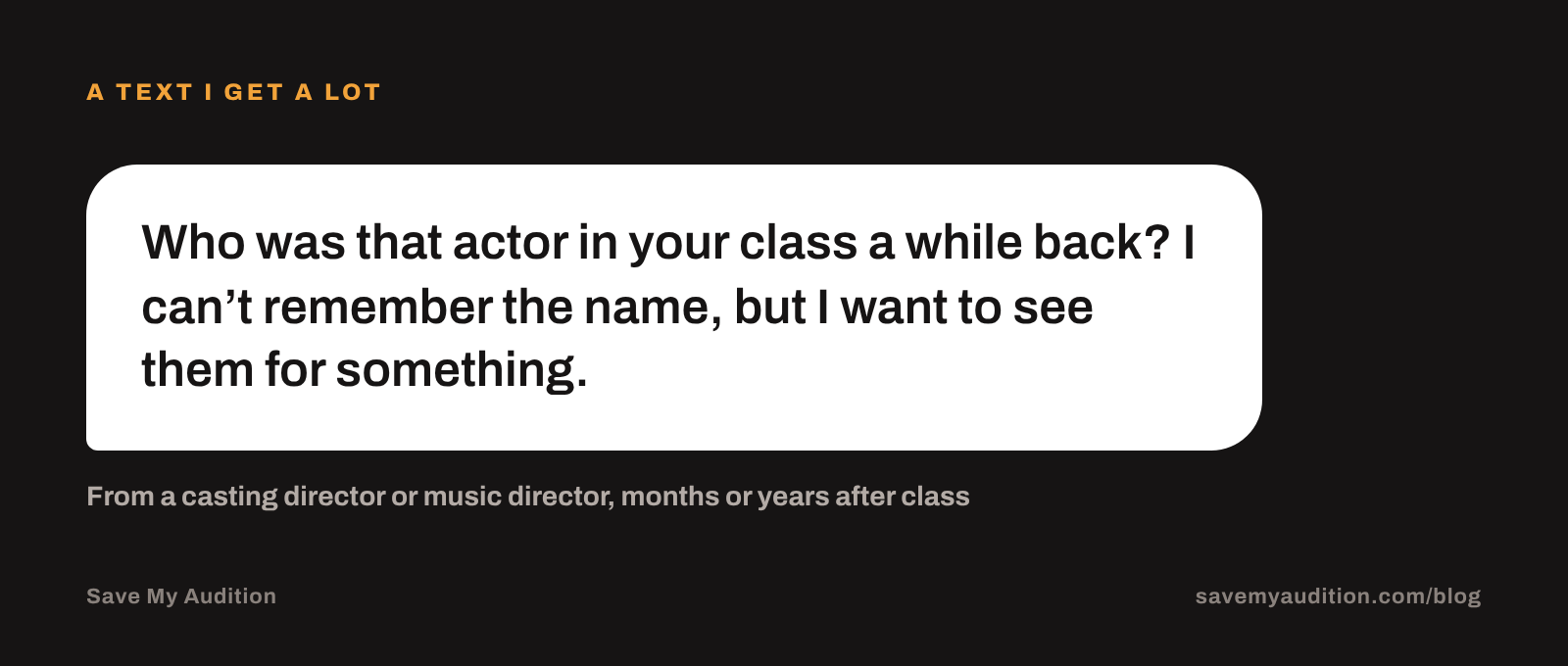
Here’s the important part: those calls usually come months or even years later, after more classes, more auditions, more training, and a lot of growth. The class started the conversation. The actor’s work, over time, is what carried it the rest of the way. The credit belongs to them.
The class started the conversation. The actor’s work carried it the rest of the way.
It looks the same from the other side of the table. Jason Thinger has talked about actors he’s seen for ten, fifteen, even twenty projects before the right one came along. Every one of those auditions counted. The relationship was growing the whole time.

Getting the most out of a class
A few things I’ve noticed about the actors who build real, lasting relationships through class:
They come to learn. They treat class as a place to grow, and it shows.
They bring material they’re ready to work on. Prepared, but open to changing it.
They take the note. Then they take the next one. Flexibility is memorable.
They follow up like professionals. A short thank-you after class, and sharing good news when it happens, like a new show. Ben Cohn’s advice here is wonderful: a specific, genuine invitation (“come see my show”) lands very differently than a request for something. Keep it warm and short, and never make anyone else responsible for your frustrations with the business.
They keep showing up. One class is an introduction. A relationship is built over many.
Why I do it this way
I started SaveMyAudition as an audition pianist looking for a better way to do classes. I wanted a room that felt honest and generous, where actors could do great work alongside people who care about great work.
That’s still the whole idea. Come in, sing or read your best, take some risks, learn something, and meet some wonderful people who do this for a living. Build those relationships one class at a time, and keep growing.