Back in December 2017 I wrote a post called “Time to Break Down Your Book.” I gave you a list of fifteen categories, from operetta to hip-hop, and told you to have a ballad and an uptempo for each one. Do the math. That’s about thirty songs.
A couple of months later, in the middle of the era series, I promised you a wrap-up post explaining why you don’t actually need that many songs. “It’ll all make sense at the end. I promise.”
Then I never wrote it. Sorry.
Here’s the upside of waiting: since 2018 I’ve played every single SaveMyAudition class. That’s a lot of hours at the piano listening to casting directors and music directors talk about audition books, and they changed my mind about a few things. So here’s the wrap-up, finally, with a lot more people in the room than just me.
The list was a map, not a shopping list
I still think that list is useful. Just not the way I wrote it.
Use the categories to find holes. If you get called in for a Golden Age revival and nothing in your book was written before 1970, that’s a hole. If every song in your book was written after 2010, that’s a hole too.
But “one ballad and one uptempo per category” isn’t the goal. In one of our pop/rock classes, a casting director talked about building your book around the work you’re actually likely to get, not around a standard checklist. Scores get more specific every season. A list I made in 2017 can’t know what you’ll be called in for next year. You can.
Every song needs a job
This is the big one.
A Broadway music director who teaches with us talks about choosing material for the information it gives the room. Not “it’s a belt song.” Not “I love this song.” What does the person behind the table learn about you in those sixteen bars that they didn’t know before?
So give every song in your book a job. Some jobs a song can have:
It sounds like the roles you’re right for.
It proves you can sing a style: legit, pop, rock, country.
It tells a story from beginning to end.
It shows your range.
It’s funny, and you’re funny in it.
It lets us see you feel something.
It’s just you. The song you’d sing if they said “sing whatever you want.”
If two songs do the same job, one of them can go. If a song doesn’t have a job, it isn’t ready for your book. Even if you love it. Especially if you love it. I said it in 2017 and I’ll say it again: just because you like a song doesn’t mean it’s a great audition song for you.
That music director also makes the point that not every song has to do everything. Your contemporary ballad doesn’t need to show your high note, your comedy and your heartbreak. Let it do its one job really well.
The same song in different fonts
One casting director who teaches with us has a great way of describing a lot of the books they see: the same song in different fonts.
Here’s what that looks like. Five songs from five different decades: a Golden Age ballad, a Sondheim ballad, a contemporary ballad, a pop ballad, a country ballad. Five different categories on my old list. But every one of them is the same sad, earnest person standing still and singing pretty. The room learns one thing about you, five times.
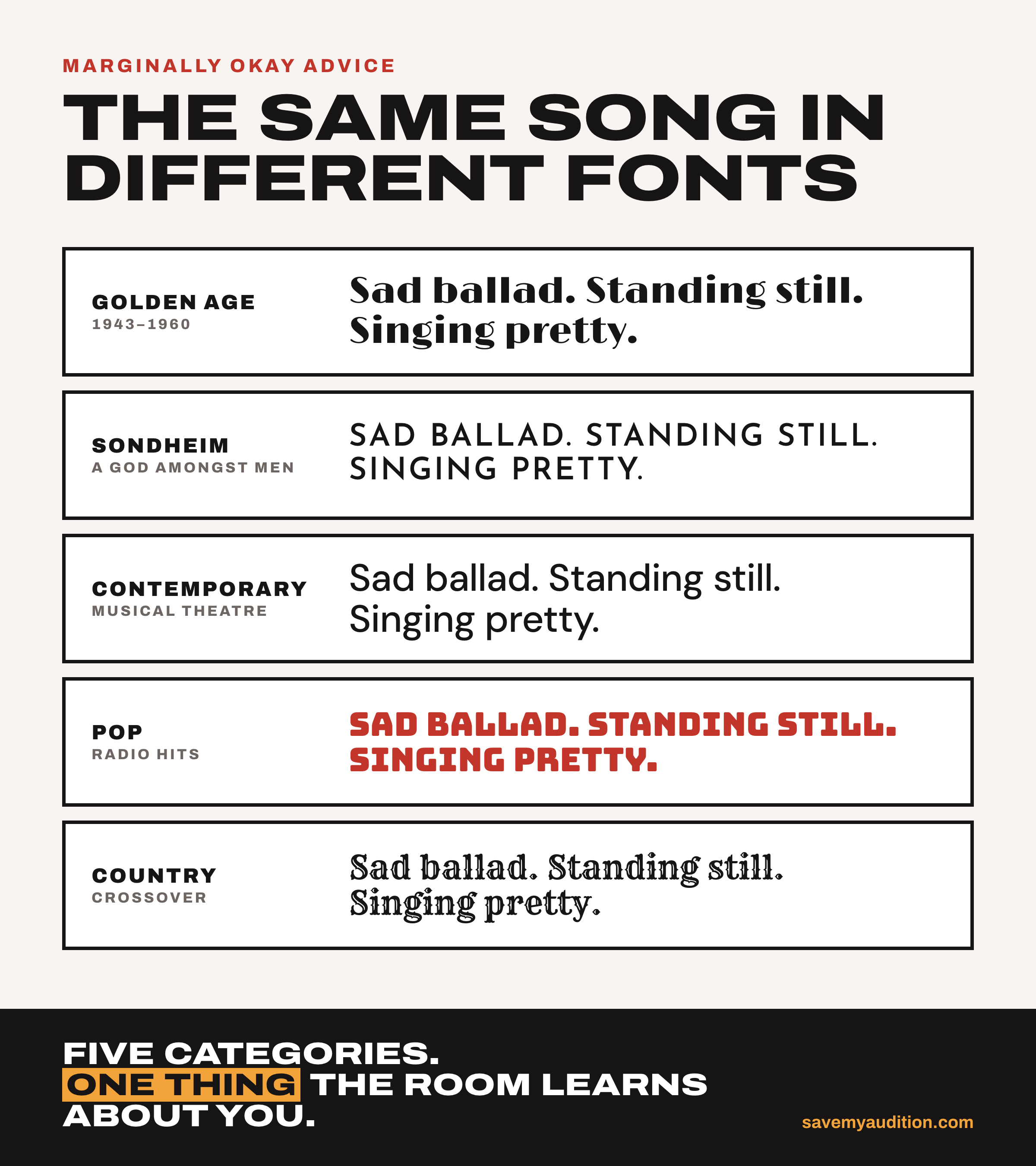
Your book should feel like the same person showing different sides. Funny you. Angry you. Rock you. Sincere you. That same casting director talks about knowing what you do and what you do best, without boxing yourself into a brand you can never get out of.
Try this: sort your songs by what they show about you, not by when they were written. If one pile is huge and the others are empty, you know what to look for next.
One song can do more than one thing
The casting director from that pop/rock class also talked about one piece of sheet music working more than one way. Slow it down, change the key, change the circumstances, and the song becomes something new.
This is how you keep your book thin. I’ve always said smaller is better. A song that can be the uptempo for one call and a slowed-down ballad for another earns its spot twice. (Need it in a second key? That’s exactly what our transpositions are for.)
Familiar songs are allowed
Back in 2017 I listed songs I didn’t think you needed, starting with Andrew Lloyd Webber, Boublil & Schönberg and Frank Wildhorn. I still wouldn’t build a book around them. But I’ve changed my mind about why.
Here’s what I’ve heard since. One casting director pointed out that a song the room already knows can actually help them remember you. Another told our class that familiar material is still useful.
An obscure song isn’t special just because nobody knows it. A famous song isn’t banned just because everybody knows it. The test is the same as always: does it have a job, and do you make it yours?
One thing that hasn’t changed: if it’s a song you wrote, read Audition Peeves #2 first. New material makes the room work harder to follow the song, and that’s time they aren’t watching you.
Lead with what you can do
Pick a first song that shows the room the thing they need, right away. A casting director put it to one of our classes this way: lead with an ability the room needs, not a song that leaves them wondering whether you have it.
The same music director talks about how much the first few bars tell them: your key, your tempo, your groove, how you breathe. Your opening song is doing its job from the very first phrase. Don’t save the good stuff for bar 14.
Keep “In the Works” in the back
In 2017 I told you to keep songs you’re still working on in a section at the back of your book. I still mean it. A Broadway music director in one of our classes put it perfectly: some songs just aren’t ready for prime time yet. That’s not a judgment on the song or on you. It’s a readiness call. A song can be great work in your voice lessons and still not be dependable in a room today.
Anything in the main part of your book, we assume is ready. The pianist might even suggest it when the table asks for more. Make sure it’s a song you can nail cold.
So, how many songs?
Fewer than my 2017 list made it sound. Enough that:
Every song has a job, and no two have the same one.
You can show the room what they need for the kind of work you get called in for.
You always have a couple of songs ready to flip to if they ask for more. (See “Can You Sing Another Song?”)
Everything in the front of the book is ready today.
For some of you that’s a dozen songs. For some it’s twice that. It was never going to be one number, and anyone who gives you one number isn’t looking at you.
Your homework
Grab your book and a pack of sticky notes.
On each song’s tab, write its job in a few words.
Find the songs with the same job. Keep the better one.
Find the songs with no job. Move them to “In the Works,” or out of the book.
Look at what’s missing. That’s your next song search.
Want a second set of ears? Bring your book to a vocal coaching with me, or bring it to a class and let a casting director or music director tell you what they hear. That’s what they’re there for.
Every audition counts.